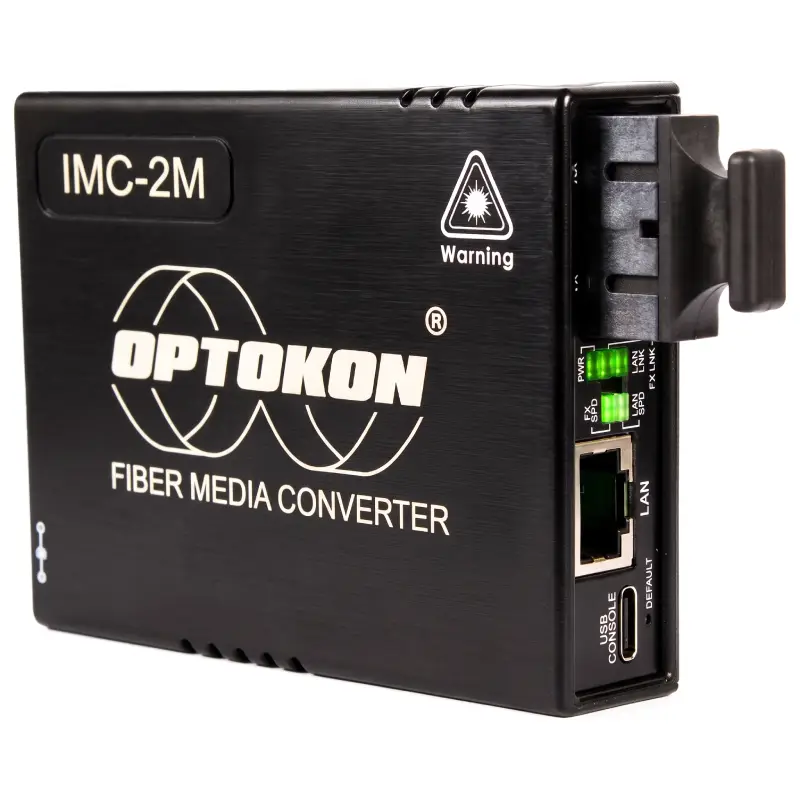
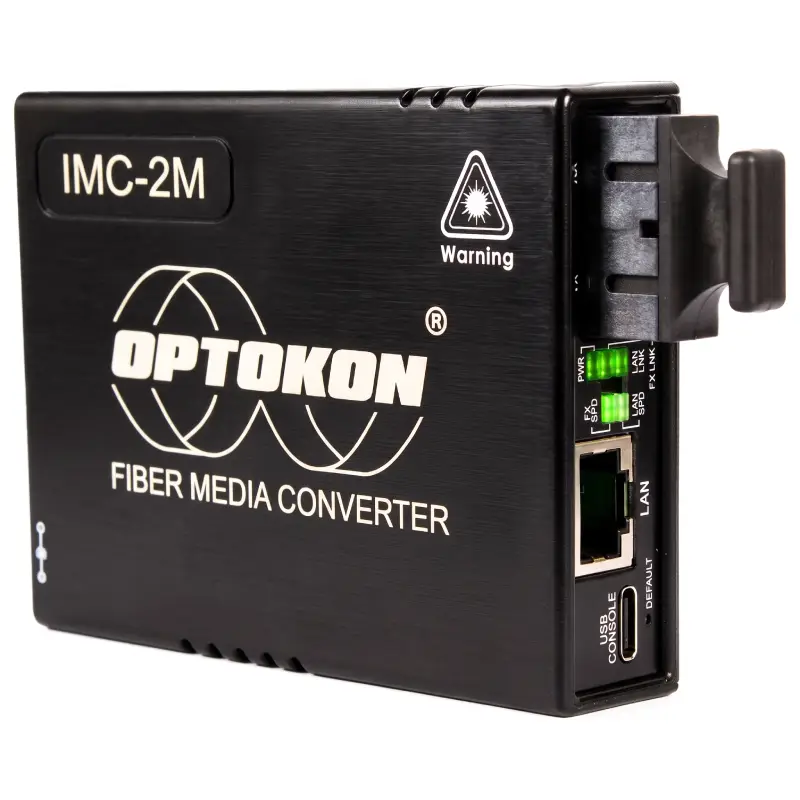
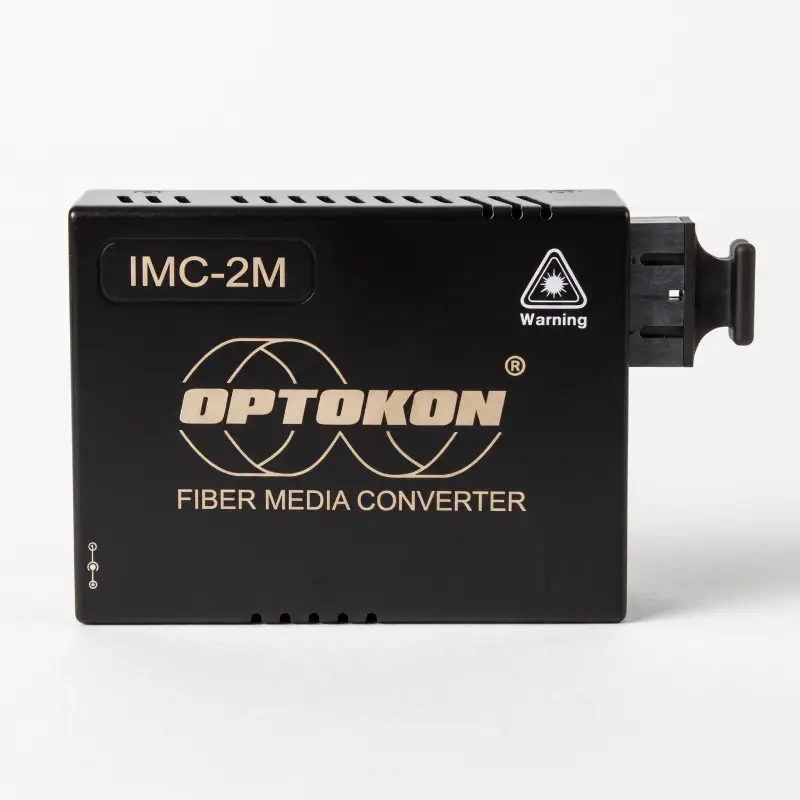
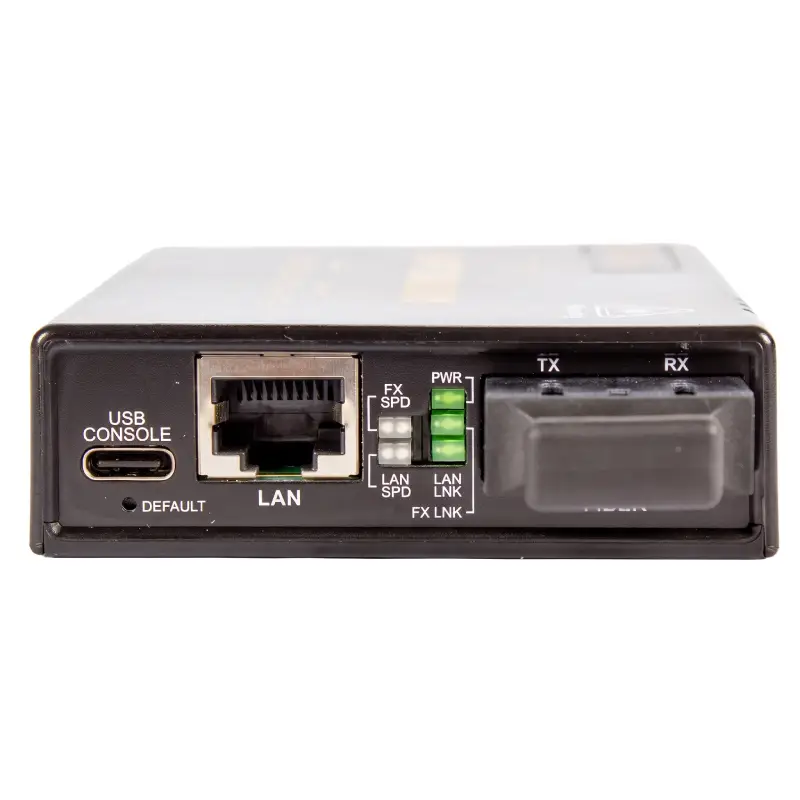
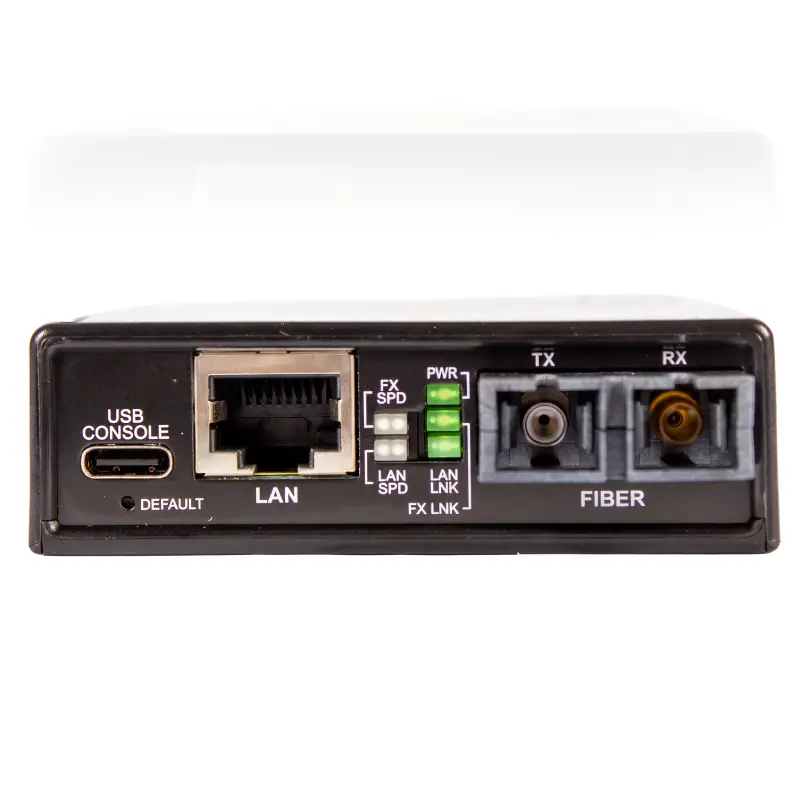
IMC-2M — managed Gigabit Ethernet media converter from 10/100/1000Base-T to 100/1000Base-X SFP
OPTOKON IMC-2M — is a managed Gigabit Ethernet media converter and compact Web Smart switch for converting copper Ethernet 10/100/1000Base-T to a fiber-optic interface 100/1000Base-X. The model is designed for professional networks that require not only media conversion but also comprehensive remote management, monitoring, VLAN, OAM, SNMP, and link status monitoring.
IMC-2M supports management via a Web interface and USB console, allowing Ethernet port configuration, bandwidth control, optical link status monitoring, VLAN configuration, and troubleshooting without physical access to the device.
The optical interface can be implemented using an SFP module or a fixed SC connection, depending on the version. Single-mode, multimode, and Bi-Di/WDM versions are available, enabling links over distances from hundreds of meters to tens of kilometers.
With support for IEEE 802.3ah OAM, SNMPv1, Digital Diagnostic Monitoring, Link Fault Pass Through, Dying Gasp and Auto Laser Shutdown IMC-2M significantly outperforms conventional unmanaged media converters and is well suited to carrier, industrial, enterprise, and mission-critical Ethernet networks.
Key advantages of IMC-2M
- 10/100/1000Base-T to 100/1000Base-X — Gigabit Ethernet conversion between copper and fiber media.
- Managed media converter — configuration and monitoring via a Web interface.
- USB Console for local administration.
- IEEE 802.3ah OAM — Ethernet link monitoring and diagnostics.
- SNMPv1 — integration into centralized monitoring systems.
- SFP Digital Diagnostic Monitoring — support for DOM/DDM-compatible modules.
- 100/1000Base-X — support for dual-rate SFP.
- Single Mode / Multimode / Bi-Di — multiple optical interface types.
- Jumbo Frame up to 16K.
- Ingress / Egress Bandwidth Control.
- Up to 16 VLAN groups.
- Link Fault Pass Through — propagation of link failure information between interfaces.
- Dying Gasp — notification of local power loss.
- Auto Laser Shutdown — automatic laser shutdown under certain fault conditions.
- RMON counters for statistics and monitoring.
- Store-and-Forward Switching.
- Auto MDI/MDIX on the RJ45 port.
- Auto-Negotiation or Manual Mode.
- Flow Control Enable / Disable.
- Desktop, wall and DIN-rail mounting.
Why use a managed media converter
A standard media converter only converts an electrical Ethernet signal into an optical signal. IMC-2M adds management and diagnostic capabilities to this function, which is especially important for remote and critical networks.
The administrator can:
- monitor the status of Ethernet and optical ports;
- check SFP parameters;
- limit Ingress and Egress rates;
- create VLANs;
- retrieve RMON statistics;
- detect optical or copper link loss;
- monitor power failure on a remote device;
- update firmware through the web interface.
Typical connection diagram
IMC-2M is installed between an Ethernet device with RJ45 and a fiber-optic link.
Ethernet switch / router / controller → RJ45 → IMC-2M → SFP or SC → optical fiber → remote network node
With its management features, IMC-2M is particularly useful for remote sites where physical access to equipment is difficult or costly.
Copper Ethernet interface
| Parameter | Value |
|---|---|
| Interface | RJ45 |
| Speed | 10 / 100 / 1000 Mbit/s |
| Mode | Half / Full Duplex |
| Auto-Negotiation | Yes |
| Manual Mode | Yes |
| Auto MDI/MDIX | Yes |
| 10Base-T cable | Cat.3 / Cat.4 / Cat.5 UTP |
| 100Base-TX cable | Cat.5 / Cat.5e or higher |
Optical interface
IMC-2M supports optical connections 100/1000Base-X. Depending on the version, the device can be equipped with an SFP slot or a fixed SC interface.
| Parameter | Value |
|---|---|
| Optical standard | 100/1000Base-X |
| Line rate | 125 / 1250 Mbit/s |
| Mode | Full Duplex |
| Interface | SFP or Duplex SC depending on the version |
| MM fiber type | 50/125 µm, 62.5/125 µm |
| SM fiber type | 9/125 µm |
Optical link options
| Type | Wavelength | Typical reach |
|---|---|---|
| Multimode | 1310 nm | 500 m / 2 km |
| Single Mode | 1310 nm | 20 km / 40 km |
| WDM Type A | 1310 Tx / 1550 Rx | Depends on the configuration |
| WDM Type B | 1550 Tx / 1310 Rx | Depends on the configuration |
| SFP | Depends on the transceiver | Depends on the installed SFP |
SFP Digital Diagnostic Monitoring
IMC-2M supports Digital Diagnostic Monitoring compatible SFP modules. This allows key optical transceiver parameters to be monitored through the management system.
Depending on the functionality of the installed SFP, the following can be monitored:
- transmitted optical power level;
- received optical signal level;
- module temperature;
- supply voltage;
- laser current.
This feature is particularly useful for remotely diagnosing optical link degradation before a complete loss of connectivity.
Web Management
IMC-2M supports management through a standard web browser. In-band management allows the device to be monitored and configured remotely over an Ethernet network.
The web interface is used for:
- configuring Ethernet ports;
- VLAN management;
- configuring Flow Control;
- bandwidth limiting;
- viewing statistics;
- SFP monitoring;
- configuring OAM;
- updating firmware.
USB Console
Local administration is available through a USB console port. This allows the device to be configured without network access, which is useful during initial setup or servicing.
IEEE 802.3ah OAM
Support for IEEE 802.3ah Ethernet OAM allows IMC-2M to be used in professional service provider and enterprise Ethernet networks.
OAM enables:
- monitoring Ethernet link status;
- detecting link errors;
- performing remote diagnostics;
- monitoring remote equipment;
- reducing troubleshooting time.
SNMPv1
IMC-2M supports SNMPv1, allowing the media converter to be integrated into a centralized network monitoring system.
This is particularly relevant for networks with a large number of remote media converters, where the administrator needs to view equipment status from a single NMS server.
Link Fault Pass Through
Link Fault Pass Through (LFPT) propagates link loss information between the copper and optical ports.
| Event | IMC-2M response |
|---|---|
| RJ45 Link Down | The media converter forces the Fiber port into Link Down |
| Fiber Link Down | The media converter forces the RJ45 port into Link Down |
This enables active equipment at the other end of the link to quickly detect that the end-to-end Ethernet connection has been disrupted.
Dying Gasp — power loss detection
The Dying Gasp function enables remote detection of media converter power loss. Before shutting down completely, the device sends an alarm notification to the management system.
This helps distinguish between:
- a fiber-optic cable break;
- an Ethernet link fault;
- equipment failure;
- loss of local power.
Auto Laser Shutdown
Auto Laser Shutdown (ALS) automatically controls the optical transmitter under certain fault conditions. This function improves operational safety and simplifies maintenance of the optical link.
Jumbo Frame 16K
IMC-2M supports Jumbo Frames up to 16K, significantly exceeding the standard Ethernet frame size.
Support for large frames is useful in networks with intensive data transfer:
- server infrastructure;
- data storage systems;
- video surveillance;
- industrial systems;
- backups;
- large file transfers.
Bandwidth Control
IMC-2M supports Ingress and Egress Bandwidth Control. The administrator can limit the bandwidth of incoming or outgoing Ethernet traffic.
This enables administrators to:
- control link utilization;
- limit traffic at an individual endpoint;
- prevent uplink congestion;
- establish bandwidth-controlled service links.
VLAN
IMC-2M supports IEEE 802.1Q VLAN and up to 16 Tag VLAN Groups.
VLAN enables logical isolation of network traffic without creating a separate physical infrastructure.
RMON
Support for RMON counters enables collection of Ethernet interface statistics and analysis of network status.
IMC-2M Technical Specifications
| Parameter | Value |
|---|---|
| Model | IMC-2M |
| Device type | Web Smart OAM/IP Managed Gigabit Ethernet Media Converter / Switch |
| Conversion | 10/100/1000Base-T ↔ 100/1000Base-X |
| Standards | IEEE 802.3, IEEE 802.3u, IEEE 802.3ab, IEEE 802.3z, IEEE 802.1Q |
| Copper interface | 10/100/1000Base-T RJ45 |
| Duplex RJ45 | Half / Full Duplex |
| Auto MDI/MDIX | Yes |
| Auto-Negotiation | Yes |
| Manual Mode | Yes |
| Optical interface | 100/1000Base-X, SFP or Duplex SC depending on the version |
| Optical data rate | 125 / 1250 Mbit/s |
| Optical Duplex | Full Duplex |
| Multimode fiber | 50/125 µm, 62.5/125 µm |
| Single Mode fiber | 9/125 µm |
| MM reach | 500 m / 2 km |
| SM reach | 20 km / 40 km |
| WDM Type A | 1310 Tx / 1550 Rx |
| WDM Type B | 1550 Tx / 1310 Rx |
| SFP range | Depends on the installed transceiver |
| Jumbo Frame | Up to 16K Bytes |
| Store-and-Forward | Yes |
| Flow Control | Enable / Disable |
| Ingress Bandwidth Control | Yes |
| Egress Bandwidth Control | Yes |
| IEEE 802.3ah OAM | Yes |
| SNMP | SNMPv1 |
| SFP DOM | Yes |
| VLAN | Up to 16 Tag VLAN Groups |
| RMON | Yes |
| LFPT | Yes |
| Dying Gasp | Yes |
| Auto Laser Shutdown | Yes |
| Management | Web Management / USB Console |
| Firmware Upgrade | On-Line via Web Manager |
| LED | Power, FX-Link, LAN Speed, LAN Link |
| Power supply | 12 V DC |
| Power consumption | < 3 W |
| Operating temperature | 0...+50 °C |
| Storage temperature | −10...+70 °C |
| Operating humidity | 10–90%, non-condensing |
| Dimensions | 96.5 × 23 × 73.4 mm |
| Weight | 120 g |
| Mounting | Desktop / Wall Mounting, DIN Rail |
| EMC | FCC, CE |
| MTBF | Over 65 000 hours |
IMC-2M and a standard unmanaged media converter
| Function | IMC-2M | Standard media converter |
|---|---|---|
| Ethernet ↔ Fiber conversion | Yes | Yes |
| Web Management | Yes | Usually no |
| SNMP | Yes | No |
| IEEE 802.3ah OAM | Yes | No |
| SFP DOM Monitoring | Yes | Usually no |
| VLAN | Up to 16 groups | No |
| Bandwidth Control | Yes | No |
| RMON | Yes | No |
| Dying Gasp | Yes | No |
| LFPT | Yes | Depends on the model |
| Jumbo Frame | Up to 16K | Depends on the model |
Carrier networks
IMC-2M is well suited for Ethernet carriers and ISPs that need to monitor remote subscriber or transport nodes.
- Metro Ethernet;
- FTTx aggregation;
- remote Ethernet nodes;
- corporate customer connections;
- carrier CPE;
- Ethernet over Fiber.
Industrial networks
With its management capabilities, optical interface and DIN-rail mounting option, IMC-2M can be used in industrial Ethernet systems.
- SCADA;
- PLC;
- production lines;
- industrial controllers;
- data acquisition systems;
- remote process nodes.
Video surveillance systems
- remote IP cameras;
- CCTV aggregation nodes;
- perimeter video surveillance;
- transport facilities;
- city security system;
- industrial sites.
Management capabilities allow administrators to remotely monitor the status of the optical link and the Ethernet connection to the remote node.
Energy and utility infrastructure
- electrical substations;
- pumping stations;
- water treatment facilities;
- telemetry systems;
- remote controllers;
- infrastructure monitoring.
Enterprise and campus networks
- inter-building connectivity;
- office complexes;
- university campuses;
- hospitals;
- logistics centers;
- warehouse complexes.
Transport infrastructure
- airports;
- railway stations;
- tunnels;
- metro systems;
- traffic controllers;
- transport terminals;
- information systems.
When to choose IMC-2M
IMC-2M is recommended if:
- a standard unmanaged media converter is not sufficient;
- remote web-based management is required;
- SNMP monitoring is required;
- OAM support is required;
- SFP DDM/DOM parameters need to be monitored;
- bandwidth limiting is required;
- VLANs are required;
- remote power loss detection is important;
- the LFPT function is required;
- Jumbo Frame support up to 16K is required;
- single-mode, multimode or Bi-Di optical links are used;
- desktop, wall or DIN-rail mounting is required.
FAQ — frequently asked questions
How does IMC-2M differ from a standard media converter?
IMC-2M offers comprehensive management and monitoring features: Web Management, IEEE 802.3ah OAM, SNMP, VLAN, Bandwidth Control, RMON, Dying Gasp and SFP DOM.
What speeds does the copper port support?
The RJ45 port supports 10, 100 and 1000 Mbit/s.
What speeds does the optical interface support?
The optical interface supports 100/1000Base-X. For the SFP version, 100 or 1000 Mbit/s operation depends on the use of a compatible dual-rate SFP.
Can SFP modules be used?
Yes. IMC-2M supports an SFP interface, and the optical link distance depends on the installed transceiver.
Is DDM/DOM supported?
Yes. IMC-2M supports Digital Diagnostic Monitoring of compatible SFP modules.
Is VLAN supported?
Yes. Supports up to 16 Tag VLAN Groups.
Can bandwidth be limited?
Yes. Ingress and Egress Bandwidth Control are supported.
What is the maximum Jumbo Frame size?
IMC-2M supports Ethernet frames up to 16K.
What is Dying Gasp?
Dying Gasp — a function that allows the device to notify the management system of a local power loss immediately before shutting down.
What is LFPT?
Link Fault Pass Through propagates the Link Down state between the copper and optical ports. If the link goes down on one interface, the device forces the link down on the other.
Can the device be managed through a browser?
Yes. IMC-2M supports Web Management and can be configured through a standard web browser.
Is SNMP supported?
Yes. It supports SNMPv1.
Can IMC-2M be mounted on a DIN rail?
Yes. DIN-rail mounting is supported, as well as desktop or wall mounting.
What power supply is required?
IMC-2M operates on 12 V DC and consumes less than 3 W.
Configuration selection
OPTOKON IMC-2M — is a professional managed Gigabit Ethernet media converter for networks where simple RJ45-to-fiber conversion is not enough. Web Management, OAM, SNMP, VLAN, RMON, Bandwidth Control, SFP DOM, Dying Gasp, LFPT and Jumbo Frame 16K allow it to serve as a fully managed network infrastructure component.
A wide range of optical options — Multimode, Single Mode, WDM/Bi-Di and SFP — allows IMC-2M to be adapted to various link types and distances, from local connections to remote links spanning tens of kilometers.
Contact us:
info@optokon.es