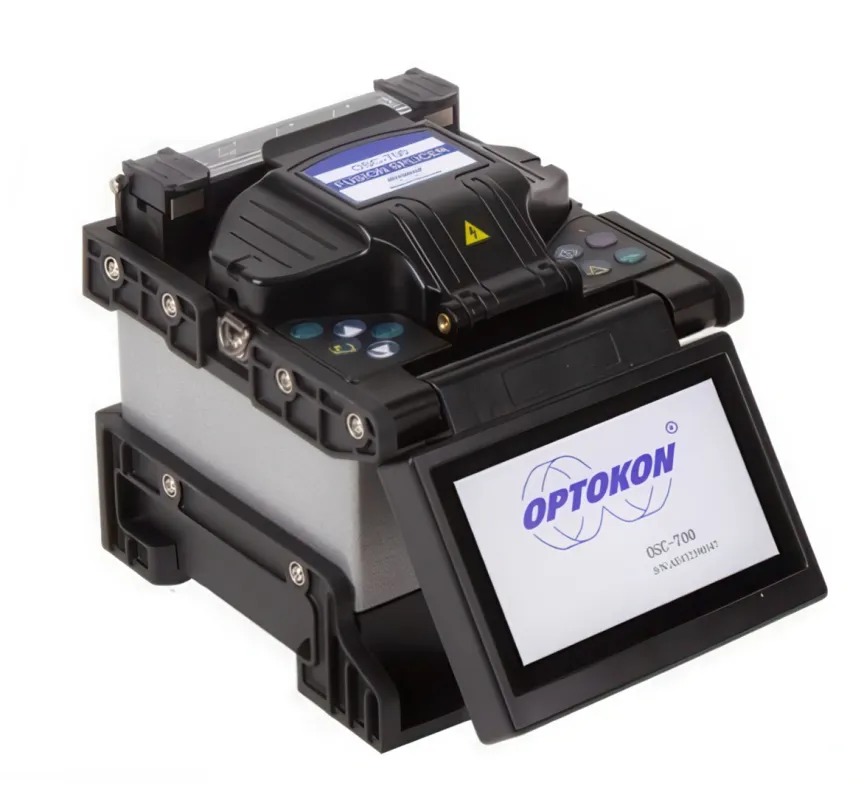
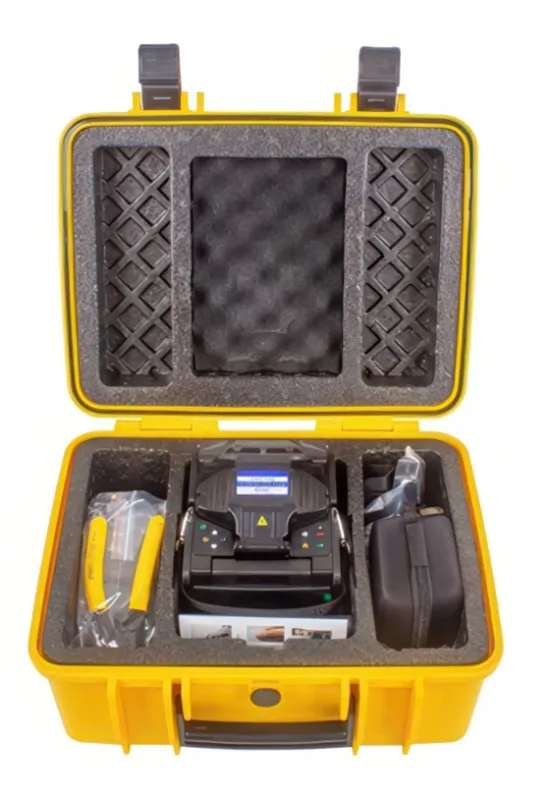
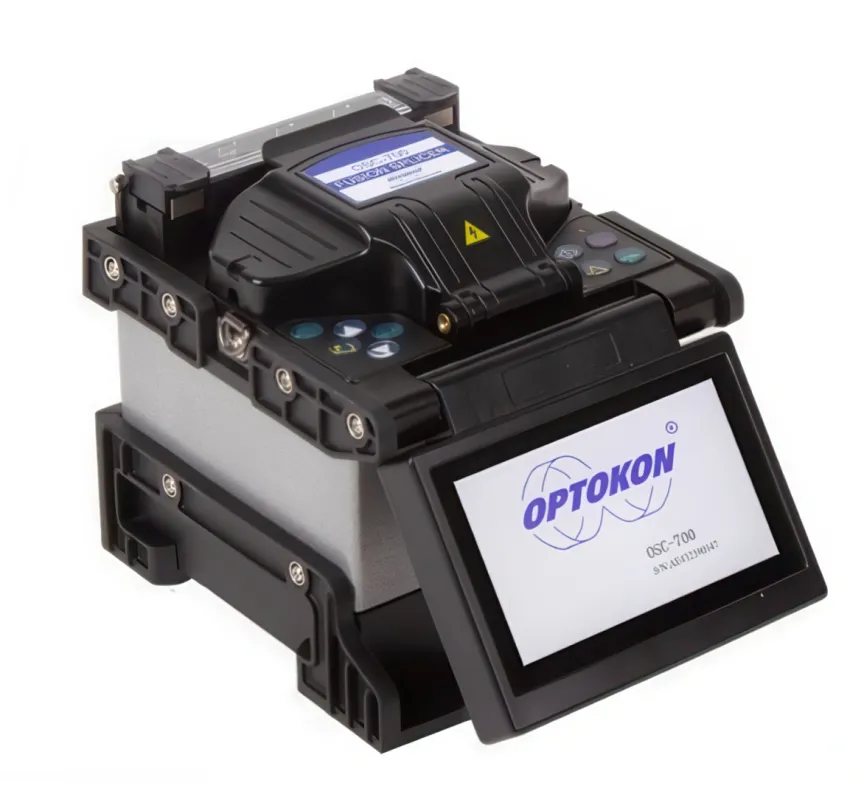
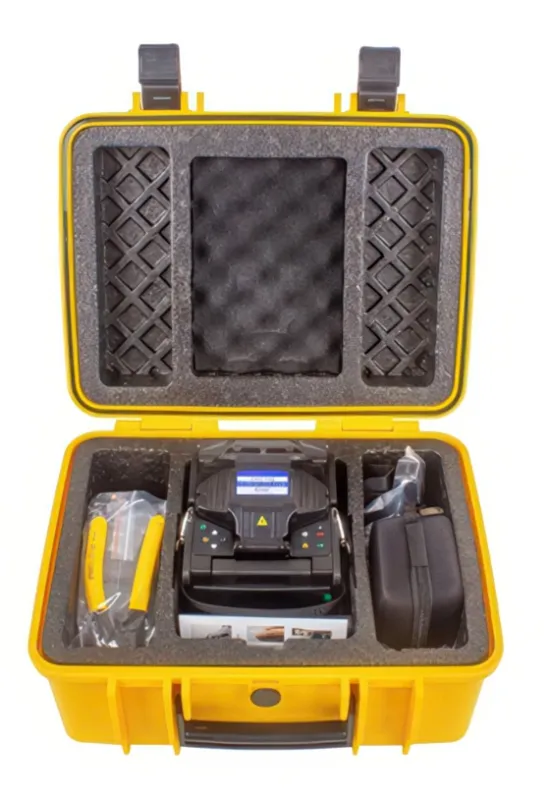
The OMK-SR-FSK.2 optical fiber splicing kit from OPTOKON is designed for field repair or restoration of mobile tactical optical cables. It includes the OSC-700 automatic fusion splicer, fiber preparation tools, a durable transport case, and all necessary accessories.
Key Advantages:
- Support for various fiber types: SM (single-mode), MM (multi-mode), DS, NZ-DS (G.655), G.657, etc.
- High splice quality thanks to core alignment using Core Alignment (PAS technology).
- Fast process: splicing time ~7 s, heating ~13 s (typical).
- Reliable housing suitable for field/heavy-duty conditions: operation at altitudes up to 5000 m, temperature from −10 °C to +50 °C.
Comparative Specifications
Main Technical Parameters
Parameter | Values |
Alignment | Core Alignment (PAS Technology) |
Supported fibers | SM, MM, DS, NZDS, G.655, G.657 |
Fiber diameter (cladding) | 80–150 µm |
Fiber coating diameter | 100–1000 µm |
Fiber stripping length before splicing | 8–16 mm |
Operating modes | Automatic, manual |
Typical splice loss | SM 0.02 dB, G.657 0.02 dB, MM 0.01 dB, DS/NZDS 0.04 dB |
Return loss | 60 dB |
Tension test | 2.0 N |
Splicing time | 7 s |
Heating time | ~13 s |
Splice memory | 8000 records |
Operating conditions | Altitude up to 5000 m; temperature −10…+50 °C; humidity up to 95% |
Kit Features
- OSC-700 fusion splicer: lightweight (2.0 kg with battery)
- Wide range of supported fiber types (including DS/NZDS) — making it a universal solution
- Designed for field use: case, portable configuration, suitable for “emergency/mobile” cable networks
- USB interface for data/stats upload and software updates
Features of the OMK-SR-FSK.2 Model
- Fiber versatility – supports both single-mode (SM) and multi-mode (MM) fibers, including “special” DS/NZ-DS types.
- Splicing speed + reliability – only ~7 seconds for a splice, precise loss metrics, high welding quality even in adverse conditions.
- Field case – the kit includes tools, a case, and durable field-ready design for tactical and mobile conditions.
- Operation in extreme conditions – altitude up to 5000 m, temperature from −10 to +50 °C, critical for field networks.
- Documentation and support – extensive specifications, splice memory, USB connectivity, multilingual interface.
- Compliance and certifications – the product has a NATO code: 1583g.
Advantages and Limitations
Advantages
- Extremely low splice losses (e.g., SM = 0.02 dB)
- Suitable for a wide range of fibers and scenarios (including DS / NZDS)
- Designed for field use — durable, mobile, fast
- Complete kit — no need to purchase many additional tools to start working
When to Buy This Kit
- If you install or repair tactical/mobile optical networks where speed, reliability, and field conditions matter.
- If you require extremely low splice losses and support for a wide variety of fiber types.
- If you need a universal solution rather than a separate splicer + basic tools.
FAQ (Frequently Asked Questions)
Question 1: What fiber types does the kit support?
Answer: SM (single-mode), MM (multi-mode), DS, NZ-DS (G.655), G.657 and others.
Question 2: What is the typical splice loss?
Answer: For example: SM ≈ 0.02 dB, DS/NZDS ≈ 0.04 dB.
Question 3: Can the kit be used in field/extreme conditions?
Answer: Yes — the kit is designed for mobile tactical cables; operating conditions include altitude up to 5000 m and temperatures −10...+50 °C.
Question 4: What are the splicing and heating times?
Answer: ~7 seconds for splicing, ~13 seconds typical for heating.
Question 5: Are all tools included?
Answer: Yes, the kit includes all necessary tools for field repair or cable replacement, along with the case.
Question 6: What is the weight of the fusion splicer?
Answer: According to the specifications, the device weighs 2.0 kg (including the battery).