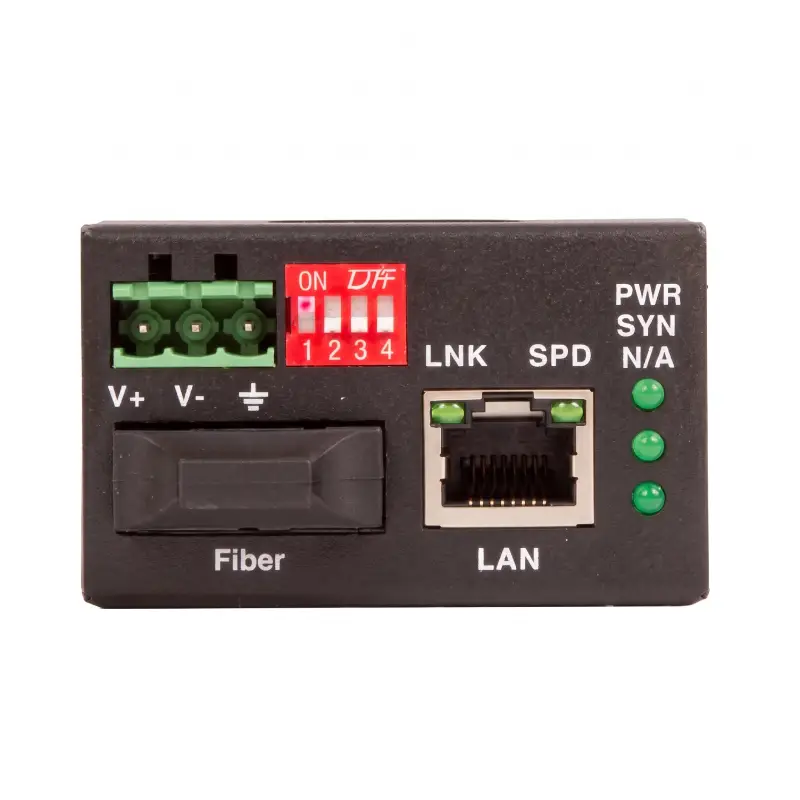
CS-1000C/E/E — industrial Gigabit Ethernet media converter 10/100/1000Base-T – 1000Base-X
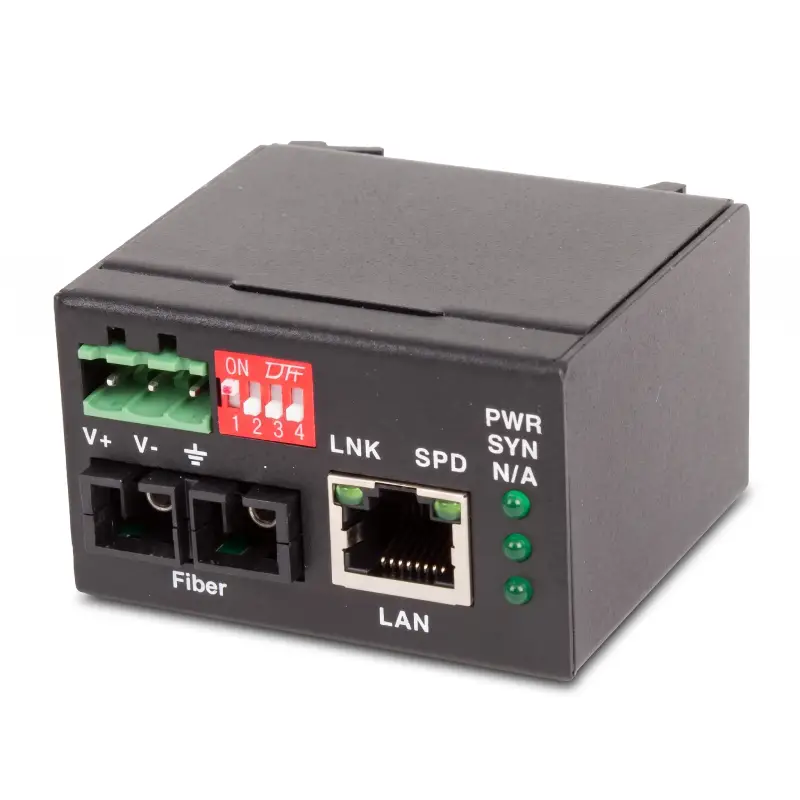
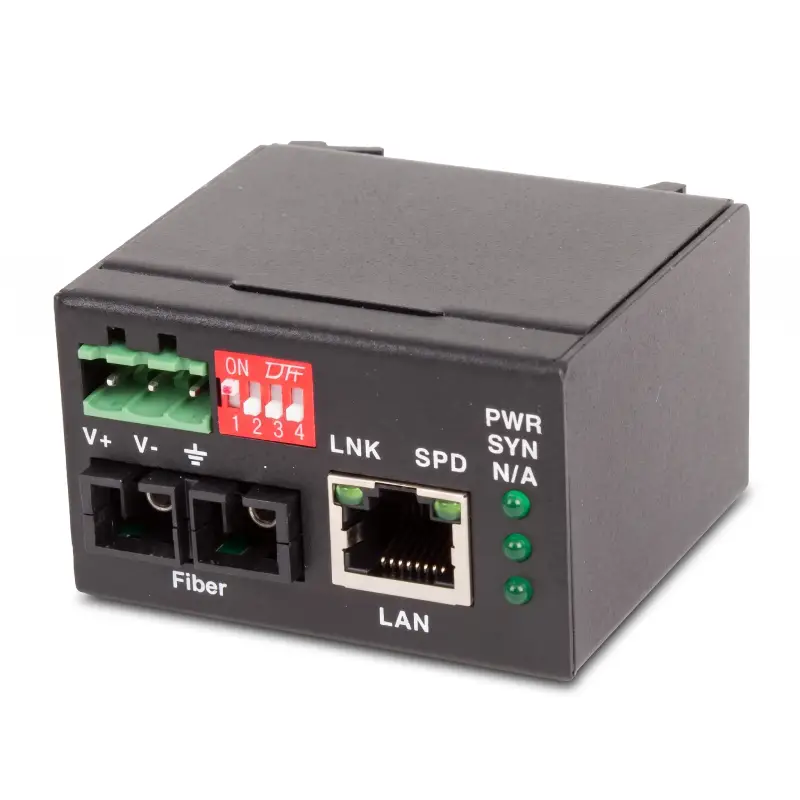
OPTOKON CS-1000C/E/E — a compact industrial Gigabit Ethernet media converter for converting an electrical interface 10/100/1000Base-T to a fiber-optic interface 1000Base-X. The device is designed for building reliable optical Ethernet links in industrial, transportation, telecommunications, energy and other networks requiring compact dimensions, DIN rail mounting and an extended temperature range.
The key difference between the CS-1000C/E/E and standard desktop media converters is its ability to operate reliably over a wide temperature range from −40 to +85 °C. This allows the device to be installed in industrial cabinets, plant facilities, transportation infrastructure, automation systems and other sites with challenging temperature conditions.
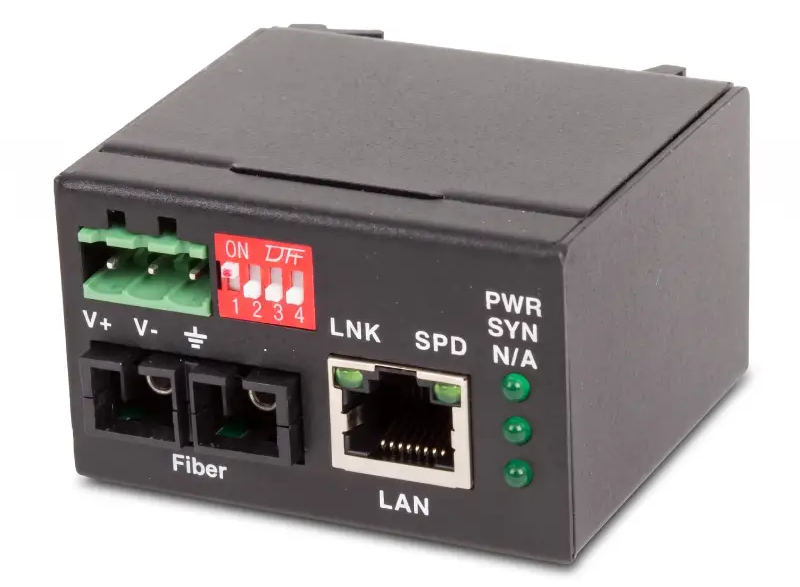
The media converter is equipped with 1 RJ45 10/100/1000Base-T port and an optical interface with Duplex SC. Depending on the version, multimode or single-mode optical links can be used. Typical reach is up to 2 km over multimode and up to 20 km over single-mode fiber.
CS-1000C/E/E supports Auto MDI/MDI-X, speed auto-negotiation, Link Fault Pass Through (LFP) and transmission of oversized Ethernet frames, including IEEE 802.1Q VLAN traffic with an MTU of at least 10240 bytes.
Key benefits of CS-1000C/E/E
- Industrial design — operating temperature from −40 to +85 °C.
- Gigabit Ethernet — conversion from 10/100/1000Base-T to 1000Base-X.
- Compact dimensions — only 53 × 61 × 38 mm.
- DIN rail mounting — easy integration into industrial and telecommunications cabinets.
- Duplex SC — reliable optical connectivity.
- Multimode and Single Mode — a choice of versions to suit the required reach.
- Up to 2 km over MM and up to 20 km over SM fiber.
- Auto MDI/MDI-X — automatic detection of the Ethernet connection type.
- Auto-Negotiation / Manual Mode for the copper Ethernet port.
- Link Fault Pass Through (LFP) for rapid detection of link faults.
- LLCF / LLR — notification of Ethernet or optical link loss.
- Support for VLANs and jumbo Ethernet frames with MTU ≥10240 bytes.
- LED indicators for power and network interface status.
- Low power consumption.
- MTBF over 50 000 hours.
Compact industrial media converter
CS-1000C/E/E features an extremely compact enclosure measuring 53 × 61 × 38 mm and weighing approximately 100 g. This allows the device to be installed in small telecommunications and industrial cabinets where a standard media converter or Ethernet switch would take up too much space.
A DIN rail mount allows the media converter to be integrated directly into automation cabinets alongside PLCs, controllers, power supplies, relays and other industrial equipment.
Optical Gigabit Ethernet beyond the limits of copper links
A standard twisted-pair Ethernet connection has a limited range. The CS-1000C/E/E converts the Ethernet signal to an optical signal for transmission over significantly greater distances.
| Transmission medium | Fiber type | Typical maximum range |
|---|---|---|
| Copper Ethernet | Twisted pair | Up to 100 m |
| Optical Ethernet MM | 50/125 or 62,5/125 µm | Up to 2 km |
| Optical Ethernet SM | 9/125 µm | Up to 20 km |
Optical fiber also provides electrical isolation between remote network segments and is immune to electromagnetic interference, which is particularly important in industrial facilities.
Interfaces
| Interface | Type | Purpose |
|---|---|---|
| Ethernet | RJ45 | 10/100/1000Base-T |
| Optical | Duplex SC | 1000Base-X |
| Power | DC | Media converter power supply |
Link Fault Pass Through — link integrity monitoring
Link Fault Pass Through (LFP) — one of the key features of the CS-1000C/E/E. In a standard media converter, the Ethernet port may remain active even after the optical link is lost. As a result, connected equipment may not detect the fault immediately.
LFP enables link loss information to be passed between the optical and copper interfaces. The functionality includes the mechanisms Link Loss Carry Forward (LLCF) and Link Loss Return (LLR).
| Fault | Result |
|---|---|
| Ethernet link loss | Fault information is passed through the optical segment |
| Optical link loss | The fault condition is propagated to the Ethernet side |
This enables network equipment to detect a fault condition faster and simplifies troubleshooting of remote optical links.
Support for VLANs and large Ethernet frames
The CS-1000C/E/E supports transparent transmission of VLAN traffic and oversized Ethernet packets. The device can be used with switches that support IEEE 802.1Q, with a frame size of MTU ≥10240 bytes.
This is important for modern enterprise and industrial networks, where the following must be transmitted transparently over the optical link:
- IEEE 802.1Q VLAN;
- Ethernet control traffic;
- video streams;
- automation system data;
- video surveillance system traffic;
- large Ethernet frames.
Auto MDI/MDI-X
The RJ45 port supports Auto MDI/MDI-X. The media converter automatically detects the type of connected Ethernet cable, eliminating the need to use separate straight-through or crossover cables.
Auto-Negotiation and manual mode
The copper Ethernet port supports Auto-Negotiation, which automatically determines the optimal speed and operating mode based on the capabilities of the connected equipment.
The Ethernet port operating mode can also be configured manually, which can be useful when integrating with specialized or industrial equipment.
LED indicators
The CS-1000C/E/E housing features LED indicators that allow users to quickly assess the status of the device and network interfaces without additional diagnostic equipment.
| Indicator | Function |
|---|---|
| PWR | Power status |
| SYN | Synchronization / optical link status |
| LNK | Network link status |
| SPD | Ethernet speed indication |
CS-1000C/E/E technical specifications
| Parameter | Value |
|---|---|
| Model | CS-1000C/E/E |
| Device type | Industrial Gigabit Ethernet media converter |
| Conversion | 10/100/1000Base-T ↔ 1000Base-X |
| Ethernet standards | IEEE 802.3 10Base-T, IEEE 802.3u 100Base-TX / 100Base-FX, IEEE 802.3ab 1000Base-T, IEEE 802.3z 1000Base-X |
| Copper port | RJ45 |
| RJ45 speed | 10 / 100 / 1000 Mbit/s |
| Auto MDI/MDI-X | Yes |
| Auto-Negotiation | Yes |
| Manual Mode | Yes |
| Optical interface | Duplex SC |
| Optical standard | 1000Base-X |
| Multimode fiber | 50/125 µm, 62,5/125 µm |
| Single-mode fiber | 9/125 µm |
| MM reach | Up to 2 km |
| SM reach | Up to 20 km |
| Link Fault Pass Through | Yes |
| LLCF / LLR | Yes |
| VLAN | Transparent IEEE 802.1Q transmission |
| Maximum frame size | MTU ≥10240 bytes |
| LED indicators | PWR, SYN, LNK, SPD |
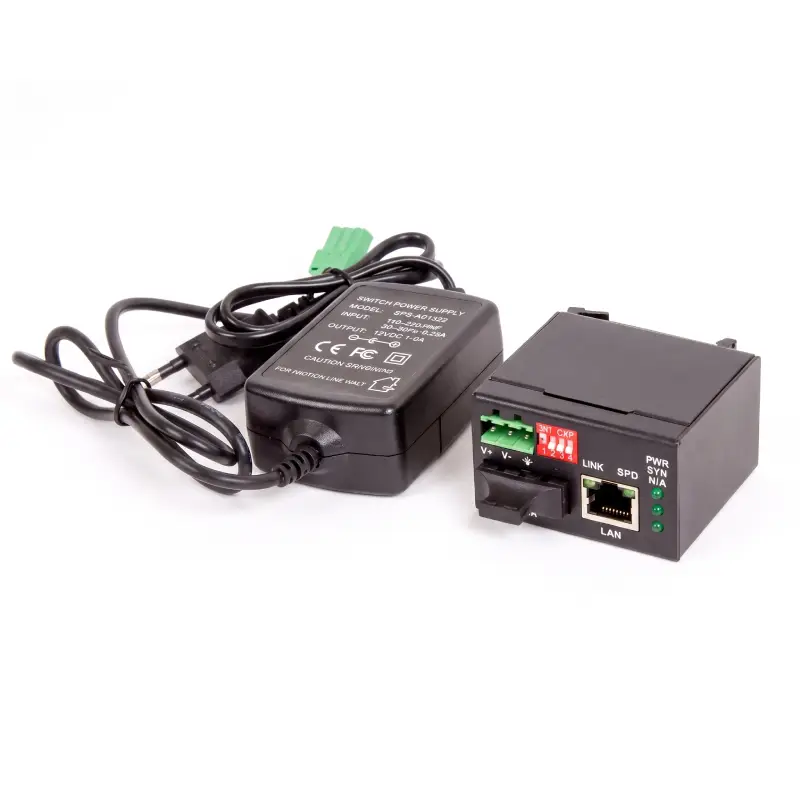
| Device power supply | 12 V DC / 0,15 A |
| Dimensions | 53 × 61 × 38 mm |
| Weight | 100 g |
| Operating temperature | −40...+85 °C |
| Storage temperature | −40...+85 °C |
| Relative humidity | 5–95%, non-condensing |
| MTBF | Over 50 000 hours |
| Mounting | DIN rail |
| RoHS | RoHS compliant |
Operation at extreme temperatures
One of the key features of the CS-1000C/E/E is its wide temperature range of −40...+85 °C for both operation and storage.
This allows the media converter to be used where standard office networking equipment is not designed to withstand the operating conditions:
- unheated equipment rooms;
- industrial cabinets;
- production facilities;
- transport infrastructure;
- remote industrial sites;
- power facilities;
- outdoor video surveillance systems when installed in a suitable protective enclosure.
Applications in industrial automation
The CS-1000C/E/E can be used to transmit Ethernet between remote industrial network segments and connect:
- PLC controllers;
- HMI panels;
- SCADA systems;
- industrial Ethernet switches;
- process equipment controllers;
- data acquisition systems;
- remote I/O systems;
- supervisory control systems.
Video Surveillance and Security Systems
Optical Ethernet transmission allows the CS-1000C/E/E to be used for remote IP video surveillance systems where distances exceed the capabilities of standard copper Ethernet.
- perimeter video surveillance;
- remote security posts;
- IP cameras;
- access control systems;
- tunnels and transport facilities;
- industrial sites;
- warehouse complexes.
Energy and SCADA
The wide operating temperature range and DIN-rail design make the CS-1000C/E/E a convenient solution for Ethernet connections in energy systems and utility infrastructure.
- electrical substations;
- solar power plants;
- wind power plants;
- pumping stations;
- water treatment facilities;
- telemetry systems;
- SCADA;
- remote process facilities.
Transport Infrastructure
- railway stations;
- metro systems;
- tunnels;
- airports;
- road infrastructure;
- road monitoring systems;
- information displays;
- remote transport terminals.
Enterprise and Campus Networks
The CS-1000C/E/E can be used beyond industrial applications. This compact media converter is suitable for establishing fiber-optic links between buildings and remote segments of an enterprise network.
- inter-building connectivity;
- office complexes;
- university campuses;
- healthcare facilities;
- warehouse complexes;
- logistics centers;
- remote equipment rooms.
Typical Connection Diagram
Ethernet device → RJ45 → CS-1000C/E/E → Duplex SC → optical fiber → remote media converter / optical switch
When to choose CS-1000C/E/E
This model is an optimal choice if:
- Gigabit Ethernet needs to be transmitted over optical fiber;
- the distance exceeds the capabilities of copper Ethernet;
- the equipment must operate at temperatures as low as −40 °C or as high as +85 °C;
- a compact industrial design is required;
- DIN-rail mounting is required;
- a fixed, reliable Duplex SC interface is required;
- LFP support is required to monitor link integrity;
- the network carries IEEE 802.1Q VLAN traffic;
- transmission of larger Ethernet frames is required;
- the application involves industrial, transportation, or energy infrastructure.
FAQ — frequently asked questions
What speeds does CS-1000C/E/E support?
The copper port supports 10/100/1000 Mbit/s, while the optical interface is used for Gigabit Ethernet 1000Base-X.
Which optical connector is used?
The media converter is equipped with a Duplex SC optical interface.
What fiber types can be used?
Versions are available for multimode fiber 50/125 or 62,5/125 µm and single-mode fiber 9/125 µm.
What is the maximum reach?
Typical reach is up to 2 km over multimode and up to 20 km over single-mode optical fiber.
How does CS-1000C/E/E differ from the standard CS-1000C?
CS-1000C/E/E is designed for industrial use and offers a much wider operating temperature range of −40...+85 °C, a compact enclosure, and DIN-rail mounting capability.
What is LFP?
Link Fault Pass Through allows information about link loss to be passed between the copper and optical sides of the media converter, enabling network equipment to detect link failures more quickly.
Is Auto MDI/MDI-X supported?
Yes. The RJ45 port automatically detects the Ethernet connection type.
Can the device be mounted on a DIN rail?
Yes. CS-1000C/E/E supports DIN rail mounting, which is particularly convenient for industrial and telecommunications cabinets.
Does the media converter support VLANs?
Yes. The device provides transparent forwarding of VLAN traffic and can work with switches that support IEEE 802.1Q.
What is the operating temperature range?
CS-1000C/E/E is designed to operate within a range from −40 to +85 °C.
Summary
OPTOKON CS-1000C/E/E — a compact industrial Gigabit Ethernet media converter for building reliable optical links between 10/100/1000Base-T devices. Support for single-mode and multimode fiber, Duplex SC, Link Fault Pass Through, Auto MDI/MDI-X, IEEE 802.1Q VLAN, jumbo Ethernet frames and DIN rail mounting makes this model a versatile solution for industrial and telecommunications networks.
The operating temperature range of −40...+85 °C allows CS-1000C/E/E to be used in harsher conditions than standard office media converters, while its compact dimensions simplify installation in existing infrastructure.
Contact us:
info@optokon.es