CS-1000C-SFP — compact 10/100/1000Base-T media converter with a 100/1000Base-X SFP slot
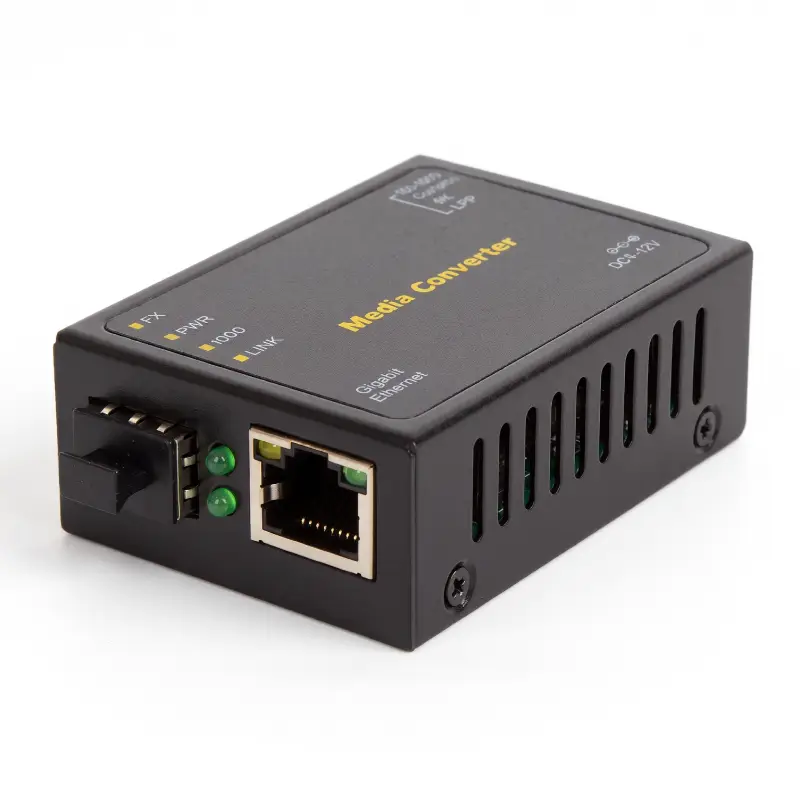
OPTOKON CS-1000C-SFP — compact Ethernet media converter for converting an electrical signal 10/100/1000Base-T into a fiber-optic signal 100/1000Base-X. The device features one RJ45 port and a universal SFP slot, allowing users to select an optical transceiver to suit the fiber type, wavelength, required reach and network topology.
Unlike media converters with fixed optics, CS-1000C-SFP does not limit the user to a single optical interface type. A suitable MM SFP can be installed for a multimode link, or an SM SFP for a single-mode link — the required reach is determined by the specifications of the selected transceiver.
The model supports Auto MDI/MDIX on the copper port, optical interface switching, 100M/1000M, Jumbo Frame up to 9K, modes Forward and Store-and-Forward, as well as the Link Fault Pass Through function for effective monitoring of end-to-end Ethernet connection status.
With dimensions of just 69 × 50 × 25 mm and a weight of 100 g CS-1000C-SFP can be easily installed in small telecommunications enclosures, video surveillance systems, network cabinets, industrial panels, BMS systems and other space-constrained locations.

Front panel

Rear panel

Power supply
Key benefits of CS-1000C-SFP
- 1 × 10/100/1000Base-T RJ45 for connecting standard Ethernet equipment.
- 1 × SFP slot for 100/1000Base-X optical modules.
- Flexible choice of optics — Single Mode or Multimode depending on the installed SFP.
- Flexible choice of reach — determined by the specifications of the SFP transceiver.
- 100M/1000M switching for use with compatible Fast Ethernet or Gigabit Ethernet SFPs.
- Jumbo Frame up to 9K for transmitting larger Ethernet frames.
- Forward Mode / Store-and-Forward Mode.
- Auto MDI/MDIX on the copper Ethernet port.
- Link Fault Pass Through for monitoring link status.
- LLCF and LLR for propagating link loss information.
- LED indication of power, TP and Fiber interface status.
- 5–12 V DC power supply.
- MTBF over 50 000 hours.
- Compact enclosure — 69 × 50 × 25 mm.
- Weight only 100 g.
- Optional wide-temperature version for more demanding operating conditions.
Versatile SFP slot
The main advantage of the CS-1000C-SFP is the use of a replaceable SFP transceiver instead of a built-in optical transmitter. This allows a single media converter model to be used for different types of fiber-optic links.
| Parameter | Configuration options |
|---|---|
| Fiber type | Single Mode or Multimode |
| Optical interface speed | 100M or 1000M depending on the mode and SFP |
| Wavelength | Determined by the installed SFP |
| Transmission distance | Determined by the installed SFP |
| Optical budget | Determined by the SFP specifications |
| Optical connector type | Depends on the SFP; the typical option is — LC Duplex |
As a result, upgrading or changing the optical link parameters often requires replacing only the SFP module, without replacing the media converter itself.
How the CS-1000C-SFP works
The media converter converts signals between copper Ethernet and the optical interface. The RJ45 port connects to a switch, router, IP camera, controller, server or other Ethernet device. An optical module matching the link parameters is installed in the SFP slot.
Typical connection diagram:
Ethernet device → RJ45 → CS-1000C-SFP → SFP → optical fiber → SFP / media converter / switch → Ethernet network
A second CS-1000C-SFP does not have to be installed at the other end of the optical link. If the active network equipment has a compatible SFP port, the fiber-optic link can be connected directly to it.
Copper Ethernet interface
| Parameter | Value |
|---|---|
| Number of ports | 1 × RJ45 |
| 10 Mbit/s | 10Base-T |
| 100 Mbit/s | 100Base-TX |
| 1000 Mbit/s | 1000Base-T |
| Auto MDI/MDIX | Yes |
| Transmission medium | Twisted pair |
SFP optical interface
CS-1000C-SFP is supplied with an SFP slot without an optical transceiver installed. The user can select an SFP to suit the specific project.
Typical options:
- 1000Base-SX — for multimode fiber;
- 1000Base-LX — for single-mode fiber;
- 100M SFP — when using the corresponding 100M mode;
- Long Distance SFP — for extended reach;
- other compatible SFPs matching the optical network parameters.
100M / 1000M switching
The media converter supports adaptive switching of the optical interface between 100M and 1000M. The mode is selected using a switch.
This is an important advantage for networks that need to use not only standard Gigabit Ethernet SFPs but also compatible 100 Mbit/s optical modules.
Jumbo Frame 9K
CS-1000C-SFP supports Jumbo Frames up to 9K. Larger Ethernet frames reduce the relative protocol overhead when transmitting large volumes of data.
Jumbo Frame support can be useful for:
- server networks;
- data storage systems;
- backups;
- large file transfers;
- video streaming;
- industrial Ethernet systems.
Forward Mode and Store-and-Forward Mode
| Mode | Operating Principle |
|---|---|
| Forward Mode | Frame forwarding with minimal latency |
| Store-and-Forward | Reception of the complete Ethernet frame before forwarding it through another interface |
Selectable modes allow the media converter to be adapted to the requirements of a specific network.
Link Fault Pass Through
Link Fault Pass Through (LFP) allows link loss information to be passed between the copper and fiber segments. The function is configured using a DIP switch.
The LFP mechanism includes:
- LLCF — Link Loss Carry Forward;
- LLR — Link Loss Return.
This allows network equipment and monitoring systems to respond more quickly to a cable break, SFP failure, or loss of connectivity on either segment.
Benefits of LFP
- rapid detection of fiber link faults;
- end-to-end Ethernet link monitoring;
- simplified remote monitoring;
- reduced troubleshooting time;
- more accurate Link Down detection by active equipment.
LED Indicators
| Indicator | Function |
|---|---|
| PWR | Media converter power status |
| TP LINK/ACT | Copper Ethernet link status and activity |
| 1000 | Gigabit Ethernet mode indication |
| Fiber LINK/ACT | Fiber link status and activity |
5–12 V DC Power Supply
CS-1000C-SFP supports a wide input voltage range of 5–12 V DC, simplifying device integration into various telecommunications and automation systems.
| Parameter | Value |
|---|---|
| Supply voltage | 5–12 V DC |
| Current | Up to 1 A |
| DC connector | 5.5/2.5 mm or 5.5/2.1 mm jack |
| AC/DC adapter input | 85–265 V AC / 50 Hz |
Compact enclosure
The dimensions of the CS-1000C-SFP are just 69 × 50 × 25 mm, and its weight is 100 g. This allows the media converter to be installed in locations where full-size network equipment is impractical or cannot be used.
- small telecommunications boxes;
- video surveillance cabinets;
- industrial electrical cabinets;
- network distribution cabinets;
- information kiosks;
- automation systems;
- local network nodes.
Standard and extended-temperature versions
| Parameter | Value |
|---|---|
| Operating temperature, standard version | 0...+50 °C |
| Operating temperature, optional version | −40...+85 °C |
| Storage temperature | −40...+70 °C |
| Humidity | 5–95% |
CS-1000C-SFP technical specifications
| Specification | Value |
|---|---|
| Model | CS-1000C-SFP |
| Device type | Compact Ethernet Fiber Media Converter |
| Conversion | 10/100/1000Base-T ↔ 100/1000Base-X |
| Standards | IEEE 802.3 10Base-T; IEEE 802.3u 100Base-TX; IEEE 802.3ab 1000Base-T; IEEE 802.3z 1000Base-SX/LX |
| Copper port | 1 × 10/100/1000Base-T RJ45 |
| Optical port | 1 × SFP slot |
| Optical data rate | 100M / 1000M, mode switching |
| Fiber type | Single Mode / Multimode depending on SFP |
| Range | Depends on the installed SFP |
| Auto MDI/MDIX | Yes |
| Transmission modes | Forward Mode / Store-and-Forward Mode |
| Jumbo Frame | Up to 9K |
| Link Fault Pass Through | Yes |
| LLCF | Yes |
| LLR | Yes |
| LED indicators | PWR; TP LINK/ACT; 1000; Fiber LINK/ACT |
| Supply voltage | 5–12 V DC, 1 A |
| DC connector | Jack 5.5/2.5 mm or 5.5/2.1 mm |
| AC/DC adapter | 85–265 V AC / 50 Hz |
| MTBF | Over 50 000 hours |
| Operating temperature | 0...+50 °C |
| Optional operating temperature | −40...+85 °C |
| Storage temperature | −40...+70 °C |
| Humidity | 5–95% |
| Dimensions | 69 × 50 × 25 mm |
| Weight | 100 g |
Advantages of the SFP version over a media converter with fixed optics
| Parameter | CS-1000C-SFP | Fixed optics |
|---|---|---|
| Fiber type | Selected via SFP | Specified by the manufacturer |
| Wavelength | Selectable via SFP | Fixed |
| Range | Depends on SFP | Fixed |
| Changing optical parameters | Simply replace the SFP | A different media converter model is required |
| Single Mode / Multimode | One media converter for both types | Usually separate models |
| Inventory | One media converter type + a set of SFPs | Several different models |
Video surveillance and security systems
CS-1000C-SFP can be used to transmit Ethernet in IP video surveillance systems where the distance between a camera, switch or video recorder exceeds the reach of copper Ethernet.
- IP cameras;
- NVR and video surveillance servers;
- perimeter security systems;
- parking facilities;
- access control checkpoints;
- remote security sites;
- city video surveillance systems.
Access control and building automation
- access controllers;
- IP intercoms;
- elevator systems;
- BMS;
- HVAC;
- building systems monitoring;
- information displays.
Enterprise and campus networks
With a suitable SFP, the media converter can be used to connect remote Ethernet segments between floors, building wings or separate buildings.
- office centers;
- universities and schools;
- hospitals and laboratories;
- dormitories;
- warehouses;
- manufacturing facilities;
- remote offices.
Industrial Ethernet networks
Ethernet transmission over optical fiber provides galvanic isolation and immunity to electromagnetic interference, which are essential in industrial environments.
- production lines;
- PLCs and Ethernet controllers;
- SCADA;
- industrial PCs;
- terminals and kiosks;
- data acquisition systems;
- remote network nodes.
Energy and utility infrastructure
- electrical substations;
- pumping stations;
- water treatment facilities;
- water supply systems;
- SCADA nodes;
- remote telemetry systems.
Transport infrastructure
- airports;
- railway stations;
- tunnels;
- metro systems;
- transport terminals;
- traffic controllers;
- information displays;
- monitoring systems.
Government and specialized facilities
The compact form factor, availability of a wide-temperature version, and flexible SFP interface also allow the CS-1000C-SFP to be used in networks at government and specialized facilities.
- control rooms;
- checkpoints;
- remote posts;
- monitoring systems;
- local telecommunications nodes.
Smart City
- urban video surveillance;
- roadside cabinets;
- Public Wi-Fi backhaul;
- Smart Parking;
- information systems;
- IoT gateways;
- urban monitoring systems.
When to choose the CS-1000C-SFP
The CS-1000C-SFP is particularly suitable when:
- a compact media converter with an SFP slot is required;
- you need to select the optical transceiver type yourself;
- a single project uses optical links of different types and lengths;
- Single Mode and Multimode support is required;
- an optical link speed of 100 Mbit/s or 1 Gbit/s is required;
- Jumbo Frame support up to 9K is required;
- Link Fault Pass Through functionality is required;
- Auto MDI/MDIX and easy connectivity are required;
- minimal dimensions are important;
- a 5 to 12 V DC power supply is required;
- an optional wide-temperature version is required.
FAQ — frequently asked questions
Is an SFP module included?
No. The CS-1000C-SFP has an SFP slot, and the optical transceiver is selected and installed separately according to the network requirements.
Can a single-mode SFP be used?
Yes. A suitable single-mode SFP must be installed for a Single Mode link.
Can a multimode SFP be used?
Yes. A suitable MM SFP is installed for a Multimode optical link.
What is the maximum reach?
The media converter itself does not have a fixed optical reach. It is determined by the specifications of the installed SFP module and the optical link budget.
Is 100 Mbit/s supported over fiber?
Yes. The CS-1000C-SFP supports switching the optical interface between 100M and 1000M modes when a compatible SFP is used.
Are Jumbo Frames supported?
Yes. The maximum Jumbo Frame size is 9K.
What is LFP?
Link Fault Pass Through allows link-loss information to be passed between the optical and copper interfaces, simplifying monitoring and troubleshooting.
What are LLCF and LLR?
These are link-loss detection mechanisms used as part of LFP to pass fault information between link segments.
Is Auto MDI/MDIX supported?
Yes. The RJ45 port automatically detects the type of copper connection.
What power supply is required?
The media converter operates on 5–12 V DC with a current of up to 1 A.
What is the operating temperature range?
The standard version operates at temperatures of 0...+50 °C. An extended-temperature version is optionally available for −40...+85 °C.
Does the CS-1000C-SFP support PoE?
No. The model is designed to transmit Ethernet data and does not supply PoE power through the RJ45 port.
Configuration selection
OPTOKON CS-1000C-SFP — a versatile, compact media converter for connecting copper 10/100/1000Base-T Ethernet to a fiber-optic network via a replaceable SFP module. The model's main advantage — the flexibility to select the fiber type, wavelength, optical budget and reach to suit a specific project.
Support for 100M/1000M, Jumbo Frame 9K, Forward and Store-and-Forward modes, Auto MDI/MDIX, Link Fault Pass Through, a wide 5–12 V DC power supply range and an optional extended-temperature version makes the CS-1000C-SFP a convenient solution for enterprise, industrial, transportation, municipal and specialized Ethernet networks.
Contact us:
info@optokon.es