CS-1000C — compact Gigabit media converter from 10/100/1000Base-T to 1000Base-X
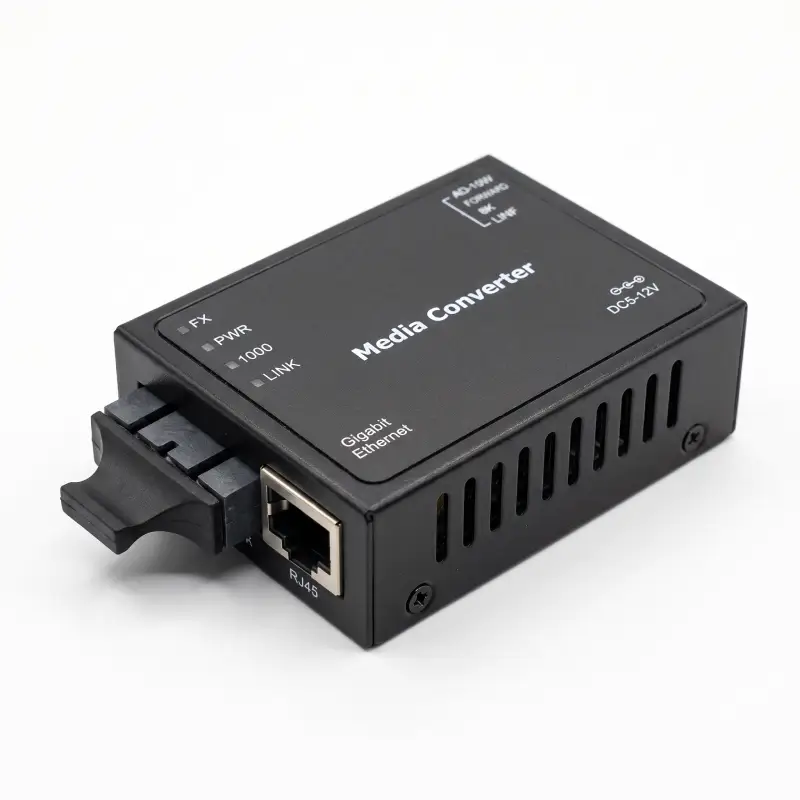
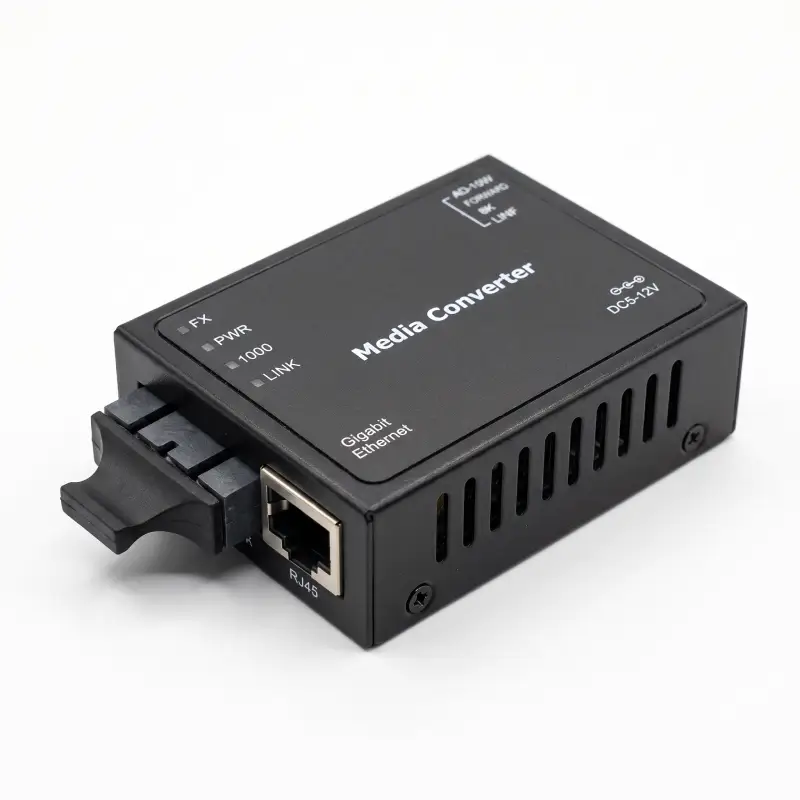
OPTOKON CS-1000C — a compact Gigabit Ethernet media converter for signal conversion between copper Ethernet 10/100/1000Base-T and a fiber-optic link 1000Base-X. The device enables quick conversion of a standard RJ45 connection to a fiber-optic link and extends the data transmission distance to 2 km over multimode fiber or up to 20 km over single-mode fiber.
CS-1000C is equipped with one RJ45 port and a duplex optical interface SC. The media converter supports both Multimode 50/125 and 62.5/125 µm, and Single Mode 9/125 µm, making it suitable for local fiber-optic networks within a building or campus, as well as inter-building and remote Gigabit connections.
The device supports Auto-Negotiation, Auto MDI/MDIX, Flow Control, Jumbo Frame up to 9K and the Link Fault Pass Through function. This makes CS-1000C more than just a basic media converter: it is a convenient, feature-rich solution for professional Ethernet networks.
Compact dimensions of 50 × 69 × 25 mm and a weight of just 100 g allow the media converter to be installed in small telecommunications enclosures, server rooms, video surveillance systems, industrial cabinets, kiosks, BMS systems, or directly next to end-user network equipment.
Key advantages of CS-1000C
- Conversion from 10/100/1000Base-T to 1000Base-X — an easy transition from copper Gigabit Ethernet to optical fiber.
- Speed up to 1 Gbit/s — for modern high-speed Ethernet networks.
- Single Mode and Multimode support.
- Range up to 2 km over MM and up to 20 km over SM.
- Duplex SC — a standard optical interface.
- Auto MDI/MDIX — automatic detection of the connection type on the RJ45 port.
- Auto-Negotiation or Manual Mode on the copper port.
- Flow Control Enable / Disable.
- Jumbo Frame up to 9K.
- Link Fault Pass Through — propagation of link loss information between segments.
- Store-and-Forward — reliable transmission of Ethernet frames.
- LED indication of power, TP port and optical link status.
- 5–12 V DC power supply — flexible integration into various systems.
- Compact enclosure — 50 × 69 × 25 mm.
- Weight 100 g.
- MTBF over 50 000 hours.
- RoHS compliance.
Operating principle
The CS-1000C is installed between an Ethernet device with a copper RJ45 interface and a fiber-optic link. A standard Ethernet cable connects to one side of the media converter, while duplex optical fiber connects to the other.
Typical connection diagram:
Ethernet device → RJ45 → CS-1000C → optical fiber → CS-1000C → RJ45 → Ethernet device
This approach allows two Ethernet segments to be connected over a distance significantly greater than the standard 100 m for copper twisted pair.
10/100/1000Base-T Ethernet port
The CS-1000C copper interface supports speeds of 10, 100 and 1000 Mbit/s, allowing both modern Gigabit equipment and older Fast Ethernet devices to be connected.
| Parameter | Value |
|---|---|
| Port type | RJ45 |
| Speed | 10 / 100 / 1000 Mbit/s |
| Standards | IEEE 802.3 10Base-T, IEEE 802.3u 100Base-TX, IEEE 802.3ab 1000Base-T |
| Auto MDI/MDIX | Yes |
| Auto-Negotiation | Yes |
| Manual Mode | Supported |
1000Base-X optical interface
The optical side operates according to the standard 1000Base-X and provides Gigabit Ethernet transmission over optical fiber.
| Parameter | Value |
|---|---|
| Standard | IEEE 802.3z 1000Base-X |
| Speed | 1 Gbit/s |
| MM fiber type | 50/125 or 62.5/125 µm |
| SM fiber type | 9/125 µm |
| Optical connector | Duplex SC |
| Maximum MM reach | Up to 2 km |
| Maximum SM reach | Up to 20 km |
Single Mode and Multimode in one family
One of the key advantages of the CS-1000C series is its support for both multimode and single-mode optical fiber.
Multimode is recommended for local area networks within buildings, campuses, industrial sites, or data centers where the distance between nodes is relatively short.
Single Mode is suitable for remote sites, inter-building connections, geographically dispersed nodes, video surveillance systems, and other applications requiring a reach of up to 20 km.
Jumbo Frame 9K
CS-1000C supports Jumbo Frame up to 9K. Using larger Ethernet frames can reduce network overhead and improve the efficiency of transferring large volumes of data in a compatible network environment.
This feature is particularly useful for:
- server connections;
- data storage systems;
- large file transfers;
- high-quality video streams;
- industrial and enterprise networks with Jumbo Frame support.
Link Fault Pass Through
Link Fault Pass Through (LFP) — a useful feature for monitoring link integrity. If one network segment loses its connection, fault information is passed to the other side of the media converter.
For example, if the optical fiber breaks, the Ethernet port on the opposite side can also enter the Link Down state. This allows a switch, router, or monitoring system to identify the problem more quickly.
Why LFP is needed
- rapid detection of a fiber-optic link break;
- proper operation of network monitoring systems;
- minimizing situations where the Ethernet Link is active but there is no actual end-to-end connection;
- easier diagnostics of remote network nodes.
Flow Control
CS-1000C allows you to enable or disable Flow Control according to the requirements of the specific network. Flow control helps reduce packet loss during brief periods of congestion and when devices process traffic at different rates.
Store-and-Forward
The media converter operates in Store-and-Forward Switch Mode. The device receives the entire Ethernet frame before forwarding it through another interface.
This approach ensures stable data transmission between copper and fiber media and enables basic Ethernet frame checks before forwarding.
Auto MDI/MDIX
Support for Auto MDI/MDIX simplifies connection to the copper network. The device automatically detects the Ethernet connection type, eliminating the need to choose between a straight-through or crossover cable.
This is especially convenient for maintenance, upgrading legacy networks, and rapid equipment installation on site.
LED indicators
LED indicators allow quick monitoring of the media converter's status without additional diagnostic equipment.
| Indicator | Function |
|---|---|
| PWR | Power status |
| TP LINK/ACT | Copper Ethernet link status and activity |
| 1000 | Gigabit mode indication |
| Fiber LINK/ACT | Fiber link status and activity |
Flexible 5–12 V DC power input
CS-1000C supports a wide input voltage range of 5–12 V DC, simplifying media converter integration into various systems.
| Parameter | Value |
|---|---|
| Input voltage | 5–12 V DC |
| Power connector | DC 5.5 × 2.1 mm |
| AC/DC adapter option | 5 V DC / 1 A |
| AC/DC adapter option | 12 V DC / 1 A |
The ability to use a 5 V or 12 V power supply makes integration convenient in telecommunications, video, automation, and other systems with different DC power sources.
Compact form factor
CS-1000C has dimensions of just 50 × 69 × 25 mm and a weight of 100 g. This allows the device to take up minimal space and be installed virtually anywhere in the network.
Typical installation locations:
- small telecommunications enclosures;
- video surveillance cabinets;
- network distribution frames;
- industrial cabinets;
- server rooms;
- BMS systems;
- kiosks and information terminals;
- local network nodes.
Full Technical Specifications for CS-1000C
| Parameter | Value |
|---|---|
| Model | CS-1000C |
| Device type | Gigabit Ethernet Fiber Media Converter |
| Conversion | 10/100/1000Base-T ↔ 1000Base-X |
| IEEE 802.3 | 10Base-T |
| IEEE 802.3u | 100Base-TX |
| IEEE 802.3ab | 1000Base-T |
| IEEE 802.3z | 1000Base-X |
| Copper interface | RJ45 |
| RJ45 speed | 10 / 100 / 1000 Mbit/s |
| Optical interface | 1000Base-X |
| Optical connector | Duplex SC |
| Multimode fiber | 50/125, 62.5/125 µm |
| Single Mode fiber | 9/125 µm |
| Typical MM reach | Up to 2 km |
| Typical SM reach | Up to 20 km |
| Jumbo Frame | Up to 9K |
| Switching mode | Store-and-Forward |
| Flow Control | Enable / Disable |
| Auto MDI/MDIX | Yes |
| Auto-Negotiation | Yes |
| Manual Mode | Yes |
| Link Fault Pass Through | Yes |
| LED | PWR; TP LINK/ACT, 1000; Fiber LINK/ACT |
| Dimensions | 50 × 69 × 25 mm |
| Weight | 100 g |
| Power input | 5–12 V DC |
| DC connector | 5.5 × 2.1 mm |
| AC/DC adapter | 5 V DC / 1 A or 12 V DC / 1 A |
| MTBF | Over 50 000 hours |
| Operating temperature | 0...+50 °C |
| Storage temperature | −40...+85 °C |
| Humidity | 5–95%, non-condensing |
| RoHS | Complies with |
Why use a fiber-optic media converter
A standard Ethernet link over copper cable is typically limited to a distance of about 100 m. A fiber-optic link extends this distance to several or tens of kilometers while also providing a range of additional benefits.
- Significantly longer transmission distance.
- Immunity to electromagnetic interference.
- Galvanic isolation between connected sites.
- No induced electrical interference on the fiber-optic link.
- Convenient connectivity between separate buildings.
- Improved stability in industrial environments.
- Ability to use existing Ethernet equipment.
Video surveillance systems
CS-1000C is well suited for building gigabit fiber-optic links in video surveillance systems, especially when multiple video streams need to be transmitted or high-resolution cameras are used.
- IP cameras;
- network video recorders;
- perimeter security systems;
- parking facilities;
- industrial facilities;
- citywide video surveillance systems;
- remote security posts.
Access control and building automation
CS-1000C can be used to connect remote network devices in BMS and security systems.
- access controllers;
- IP intercoms;
- elevator systems;
- BMS;
- HVAC controllers;
- digital information displays;
- building monitoring systems.
Enterprise and campus networks
With support for Gigabit Ethernet and Single Mode fiber, CS-1000C is a convenient solution for connecting separate buildings or remote network nodes.
- office centers;
- university campuses;
- schools;
- dormitories;
- hospitals;
- laboratories;
- warehouses;
- remote offices.
Industrial networks
Fiber-optic transmission is particularly useful in industrial environments where copper Ethernet links may be affected by electromagnetic interference.
CS-1000C can be used to connect:
- production lines;
- industrial PCs;
- Ethernet controllers;
- kiosks;
- terminals;
- data acquisition systems;
- local server nodes.
Utilities and SCADA
The media converter can be used in distributed energy and utility infrastructure networks.
- water treatment plants;
- pumping stations;
- electrical substations;
- water supply systems;
- SCADA;
- infrastructure monitoring;
- remote telemetry nodes.
Transport Infrastructure
CS-1000C is suitable for building fiber-optic Ethernet links at major transport facilities.
- airports;
- railway stations;
- tunnels;
- transport terminals;
- monitoring systems;
- information displays;
- video surveillance networks.
Retail and Hospitality
The media converter can be used in retail and hotel complexes where network nodes are located far apart.
- POS systems;
- back-office networks;
- digital signage;
- network terminals;
- hotel infrastructure;
- shopping centers.
Smart City
CS-1000C can also be used in urban telecommunications infrastructure.
- urban video surveillance;
- roadside cabinets and controllers;
- Public Wi-Fi backhaul;
- monitoring systems;
- Smart City terminals;
- information systems.
When to Choose CS-1000C
CS-1000C is an optimal solution if:
- speeds up to 1 Gbit/s are required;
- Ethernet needs to be transmitted over distances greater than 100 m;
- Multimode or Single Mode fiber is used;
- a range of up to 20 km is required;
- standard SC connectors are required;
- LFP is an important feature;
- Jumbo Frame support is required;
- Auto MDI/MDIX and Auto-Negotiation are required;
- compact dimensions are important;
- 5–12 V DC power is required.
FAQ — frequently asked questions
What speed does the CS-1000C support?
The copper port supports 10/100/1000Base-T, while the optical side operates according to the 1000Base-X standard at a speed of 1 Gbit/s.
What fiber types are supported?
Support is provided for both Multimode 50/125 and 62.5/125 µm and Single Mode 9/125 µm.
What is the maximum transmission distance?
Up to 2 km over multimode fiber and up to 20 km over single-mode fiber.
Which optical connectors are used?
The CS-1000C is equipped with a Duplex SC optical interface.
Does the device support Jumbo Frame?
Yes. Ethernet frames up to the following size are supported: 9K.
What is Link Fault Pass Through?
LFP allows link loss information to be passed from one side of the media converter to the other. This simplifies troubleshooting of the optical and copper sections of the network.
Is Auto MDI/MDIX supported?
Yes. The TP port automatically detects the copper connection type.
Is Auto-Negotiation available?
Yes. The RJ45 port supports Auto-Negotiation as well as Manual Mode.
What power supply is required?
The device supports an input power supply of 5–12 V DC via a 5.5 × 2.1 mm connector.
What is the operating temperature?
The operating temperature range is 0...+50 °C.
Is the CS-1000C suitable for IP cameras?
Yes. This model is particularly well suited to systems with high bitrates, multiple video streams or gigabit network nodes.
Does the media converter support PoE?
No. CS-1000C transmits Ethernet data but does not supply PoE power to the connected device.
Solution selection
OPTOKON CS-1000C — a compact Gigabit Ethernet media converter for converting 10/100/1000Base-T to a 1000Base-X fiber-optic link. Support for Single Mode and Multimode, a reach of up to 20 km, Jumbo Frame 9K, Auto MDI/MDIX, Auto-Negotiation and Link Fault Pass Through make it a versatile solution for enterprise, industrial, transport and municipal networks.
This model is particularly well suited to IP video surveillance, inter-building links, SCADA, BMS, campus networks, transport infrastructure and other applications requiring Gigabit Ethernet transmission over optical fiber.
Contact us:
info@optokon.es